Last updated September 2026
Most special occasion dinners are decided weeks out and booked three days out, which is the wrong way round. The booking is where nearly everything that can go wrong gets fixed, and it takes about four minutes if you know what to cover.
★View the Best Restaurants in Hamilton→Book earlier than feels necessary
The good tables in any town go first, and they go by day rather than by month. Friday and Saturday evenings fill weeks ahead in Hamilton, and a restaurant that opens five days rather than seven has fewer of them to give away in the first place.
If your date is fixed, ring as soon as you know it. If your date is flexible, say so, because a Tuesday or a Wednesday at a good restaurant is often a better experience than a Saturday: the kitchen is calmer, the room is quieter, and you are more likely to get the table you actually wanted.
Online booking is fine for a straightforward table. If the occasion matters, or if anything below applies, ring as well, because you will find out in thirty seconds what a booking form takes a day to tell you.
Say what the occasion is
This is the single highest-value sentence in the whole conversation and most people leave it out, apparently out of politeness.
Told it is an anniversary, a birthday or a farewell, a restaurant has the option of seating you somewhere better and pacing the meal to suit. Told nothing, it has no option at all, because the booking just says “table for four”. If you are hoping for anything in particular, a candle on a dessert, a table away from the pass, ask when you book rather than assuming.
It also protects you from the obvious: being put next to the door, or on the six-top that has just been given a birthday party.
Deal with dietary requirements at the booking, not on the night
Say it when you book, name the person, and be specific about whether it is an allergy or a preference. Those are handled very differently in a kitchen, and both are handled badly at eight o’clock on a Saturday when nobody was warned.
The reason it matters more at the better end of the market is that the food is made rather than assembled. A dish built around a sauce that was started that morning cannot always be reworked on the spot. So ask what the kitchen can do with notice, and ask it at the booking. The answer might be a substitution, it might be something made for the person, and it might be that a particular dish is off the table entirely. All three are fine to know a week out and much less fine to discover once everyone is seated.
Many restaurants run a separate vegetarian menu, which is worth asking about rather than assuming, alongside the main one.
Ask how long to allow, and mean it
A long dinner is a feature, not a delay, but it only works if everyone knows.
Dishes cooked to order genuinely take the time they take. A slow-cooked main might ask for half an hour from the point you order. A pastry dessert baked to order might ask for twenty-five minutes, which means ordering it before you have finished your main rather than after. Bread baked fresh for the table is the same idea at the start of the meal.
None of this is a problem if you have allowed three hours. All of it is a problem if you have a film booked.
The related question is doneness. Some dishes have a default the kitchen recommends, and asking for it another way can double the cooking time. That is worth knowing when you order rather than when everyone else’s food arrives.
Consider letting the kitchen decide
Set menus, where you choose the number of courses and the kitchen chooses the dishes, are the easiest way to eat well at a restaurant you do not know.
You are getting what the kitchen is proudest of that week, usually including things that are not on the à la carte. It removes the twenty minutes of everyone reading a menu and asking what other people are getting. And it paces the meal properly, which is most of what makes a long dinner feel good rather than long.
The usual add-on is a beverage match, a glass chosen for each course. It is a better introduction to what the kitchen is doing than picking a bottle blind, and it works out about as well as ordering by the glass anyway.
Set menus are normally for the whole table, so agree it in the group chat before you book, not at the table.
Sort the practical end before you leave home
Hamilton East is a short drive from the central city and parking is mostly on-street, so allow ten minutes at the end of the journey rather than arriving on the hour.
Two other things worth checking when you book: whether there is a minimum spend or a set menu requirement for larger groups, and how they handle splitting the bill. A restaurant that splits happily will say so; one that would rather not will also say so, and it is much easier to organise a transfer beforehand than to work it out at the table.
If you are going to be late, ring. Tables are usually held for a set time and the kitchen has been planning around your arrival. Most places, including Thyme Square, take bookings online as well as by phone, so the easiest approach is to make the booking online and follow it with a call if any of the above applies.
When a gift card is the better present
If the occasion is someone else’s, a gift card is often the stronger option, because it hands them the choice of date.
The common mistake is treating it as the lazy version of a present. It is the opposite if you pair it with actually booking the table, or with telling them you will book whenever suits. What people value is the evening, not the piece of card.
Where Thyme Square fits
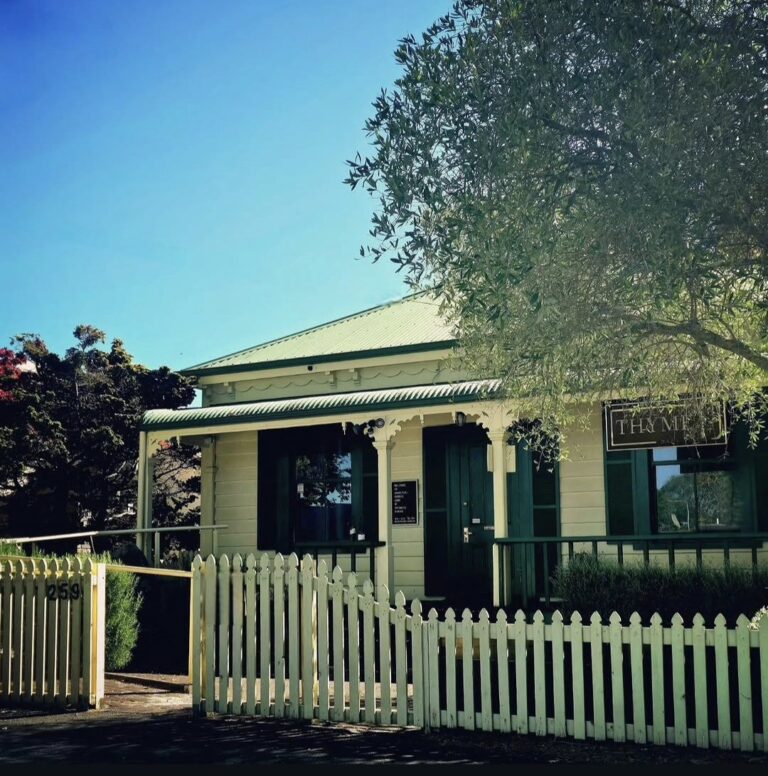
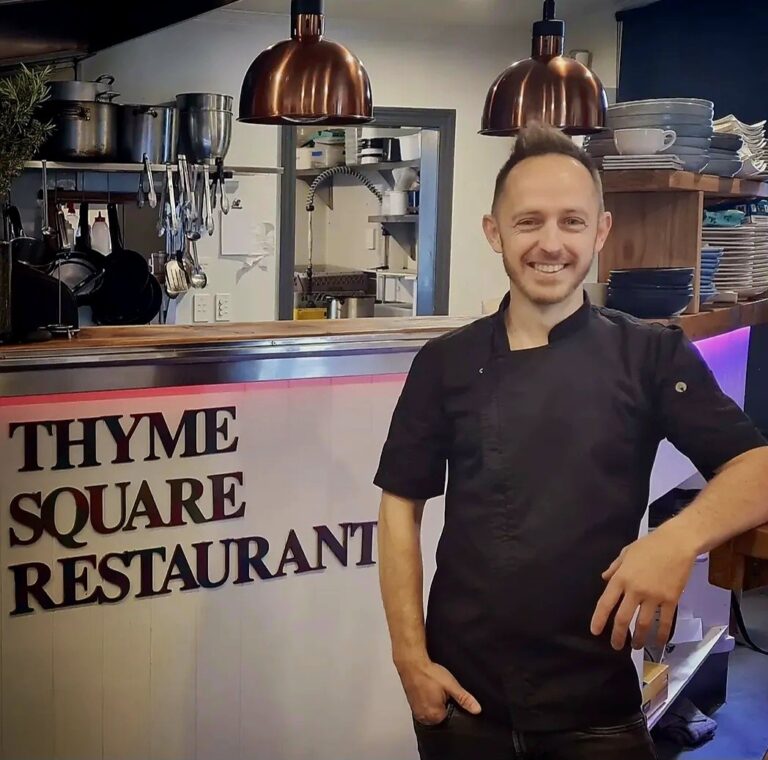
Thyme Square is at 259 Grey Street in Hamilton East, open Tuesday to Saturday from 2pm to 10pm, with Logan Murray in the kitchen. It is a small room, which is the point rather than a limitation, and it is the reason the booking conversation above is worth having.
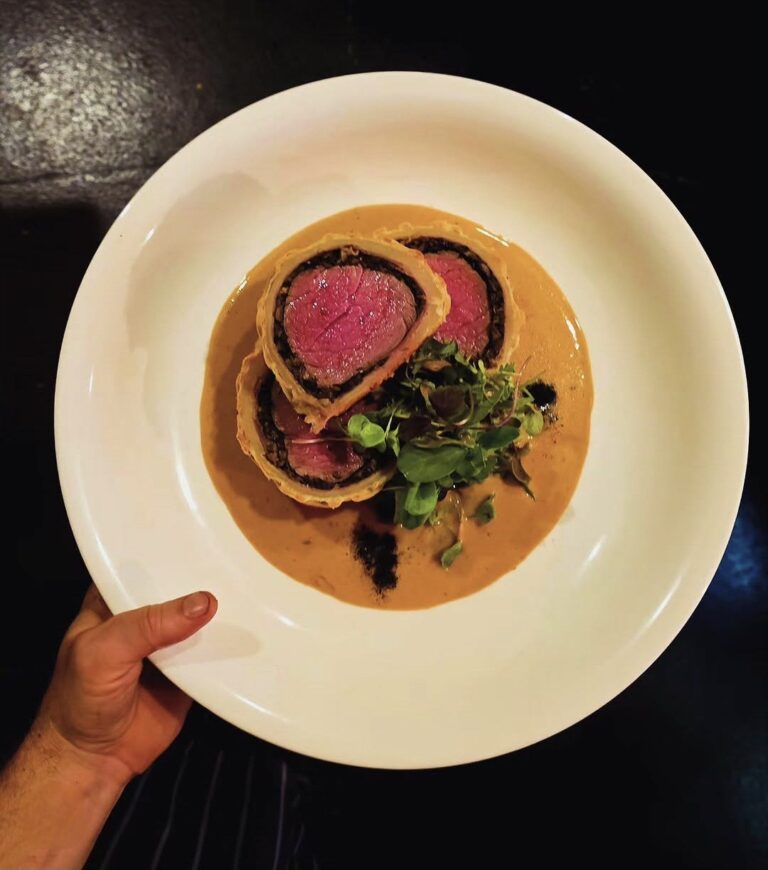
On the specifics: they run a “Trust the Chefs” set menu at two, three or five courses with an optional beverage match at each level, which is the option described above. Mains ask for a minimum of half an hour, the pear tarte tatin asks for twenty-five, and the rēwena loaf is baked to order for the table, so this is an evening to allow proper time for. The Beef Wellington is cooked pink as standard and takes twice as long done through, and can be split across two plates for sharing. There is a separate vegetarian menu and a drinks list. Gift cards are available, and lunch functions are arranged by enquiry rather than being on the standard timetable.
Wherever you end up going, ring rather than email, say what the occasion is, and allow more time than you think. That covers most of it.